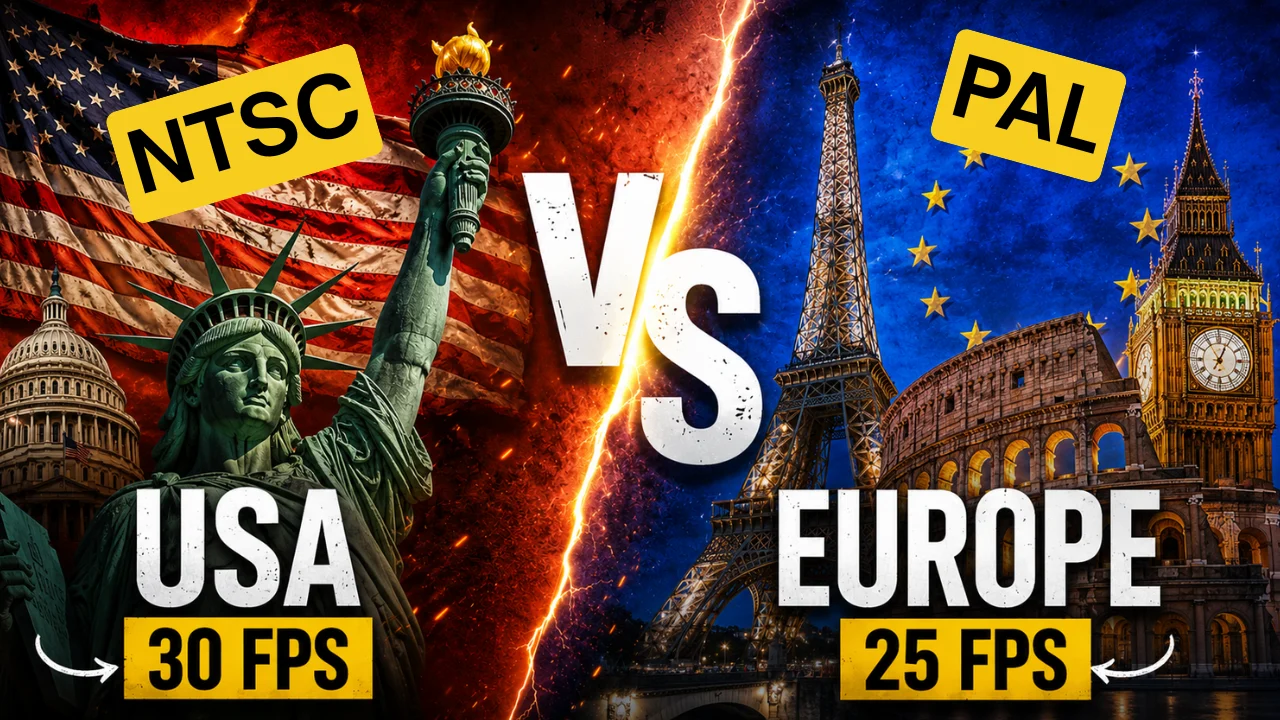
You've already filmed inside and got an image with inexplicable light jumps (what they call « flicker »)? Have you ever hesitated between 25fps and 30fps in your camera menus without really knowing what to choose or why? Time to understand everything!
With this article, you will finally understand the differences between the PAL and NTSC, 25 and 30 fps, and the video formats and standards.
This problem — very common but often poorly understood — has a simple answer. And it has two acronyms: PAL vs NTSC.
We recently produced this video to answer this question.
This article is the written extension.
PAL vs NTSC: where do these two standards come from?
To understand these formats and this global duel PAL vs NTSCWe must go back to the post-war period. In the 1940s-1950s, television began to democratize, and each region of the world developed its own broadcasting standard.
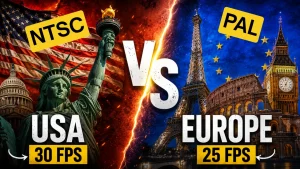
NTSC (National Television System Committee) is the American standard. Developed in 1941 and deployed massively in the United States as early as the 1950s, it works at 29,97 images per second — often rounded to 30 in the menus — on an electrical network 60 hertz. That is to say, the electric current makes 60 round trips in 1 second, that is 120 passages.
The PAL (Phase Alternative Line) is the European standard. Developed in Germany in the 1960s, it was gradually adopted by the majority of Europe, Australia, and much of Asia and Africa. It works at 25 images per second on an electrical network 50 hertz. That is to say, the electric current makes 50 round trips in 1 second, that is 100 runs.
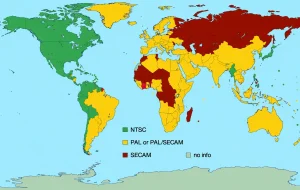
And for the French, a little national pride: ESAM (Sequence Colour to Memory) was invented in France. It shares the rate of 25 images per second and the network at 50 Hz with the PAL, but with a different color encoding. France used it until the end of the 1980s, before switching to the PAL to align with the rest of Europe.
Why 25fps in Europe and 30fps in the United States?
The answer is purely technical.
Everything comes from the power grid. The alternating current operates at 60 Hz in the United States and Canada. In Europe, it turns at 50 Hz. The first cameras and televisions were directly synchronized on this frequency to avoid interference in the broadcast image. The Americans set their standard on 30 images per second (60 Hz ÷ 2), and the Europeans on 25 images per second (50 Hz ÷ 2).
It is a legacy of infrastructure, not a creative choice. And it continues to structure all your shooting settings today.
PAL vs NTSC, the technical duel
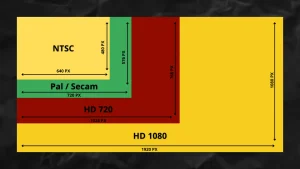
On the resolution: the PAL displays 625 lines against 525 for the NTSC. At the time of analogue television, the PAL therefore offered a slightly finer and more detailed picture. — which earned him a reputation of superior quality.
On the colors: That's where the PAL takes its name. Phase Alternative Line means that the color signal phase is reversed at each line, allowing automatic correction of transmission errors. The NTSC is more sensitive to colorimetric drifts. That's why American technicians called him (with humor) « Never The Same Color » — Never the same color. A set joke, but it said something real.
What it really changes for your shootings today
PAL vs NTSC appear to belong to the analog television era. But their legacy is well present in your daily settings. Understanding their logic thus avoids concrete mistakes on the ground.
The problem of sparkling indoors
This is the most telling example. In Europe, our artificial lights (neon, LEDs, spots) work on a 50 Hz network. If you film at 30fps in a European interior, your image frequency is not synchronized with that of your lighting, and you get light jumps in your plans.
Film at 25fps or 50fpsAnd the problem disappears. Because you're back in sync with the power grid. It is exactly the same logic that is behind the PAL.
Deliver content for the US or Japanese market
If you produce content for customers or broadcasters in the United States or Japan, delivery will be in 29.97fps. This is a parameter to anticipate from the shoot.
Choose slow motion
The PAL vs NTSC logic also applies to your idles. In PAL territory, you turn your slow down at 50fps to read them at 25fps. In NTSC, you turn to 60fps to read them at 30fps. Mixing the rhythms without consistency in a project means exposing yourself to problems of fluidity in the assembly.
PAL vs NTSC in the digital age: a still relevant duel?
With the transition to digital and high definition, PAL and NTSC standards in the strict sense have gradually disappeared from television broadcasting. Streaming platforms, modern cameras, editing software are no longer linked to these formats in the same way.
A Sony FX3 or Red Raptor can run in 25fps as in 29.97fps. You choose according to your broadcast destination. YouTube accepts both. Modern screens adapt.
But the terms PAL vs NTSC remain present in many camera menus, in some mounting software, and in the technical specifications of diffusers. Understanding them is understanding them. why your camera offers you these precise options and make informed rather than random choices.
The simple rule to remember
You film in France or Europe, set your camera to 25fps (or 50fps for idles). Your shutter speed will be at 1/50th second to comply with the 180° rule. You will avoid flickering and you will be in the standard distribution of your territory.
You film in the United States, Japan or for a NTSC client, pass on 29.97fps (or 60fps for idles). Speed of closure at 1/60th second.
You deliver for both markets, turn in 25fps and discuss upstream with your customer the frequency of delivery. Better clarify this before the foreground than during editing.
Herblot Productions is an audiovisual production company based in Bordeaux, specialized in corporate films, advertising, documentary, VSL videos, development of YouTube channels and event recordings. Contact us to learn more, it's free!